Apps and tools
Give each bot the apps it needs, and nothing more
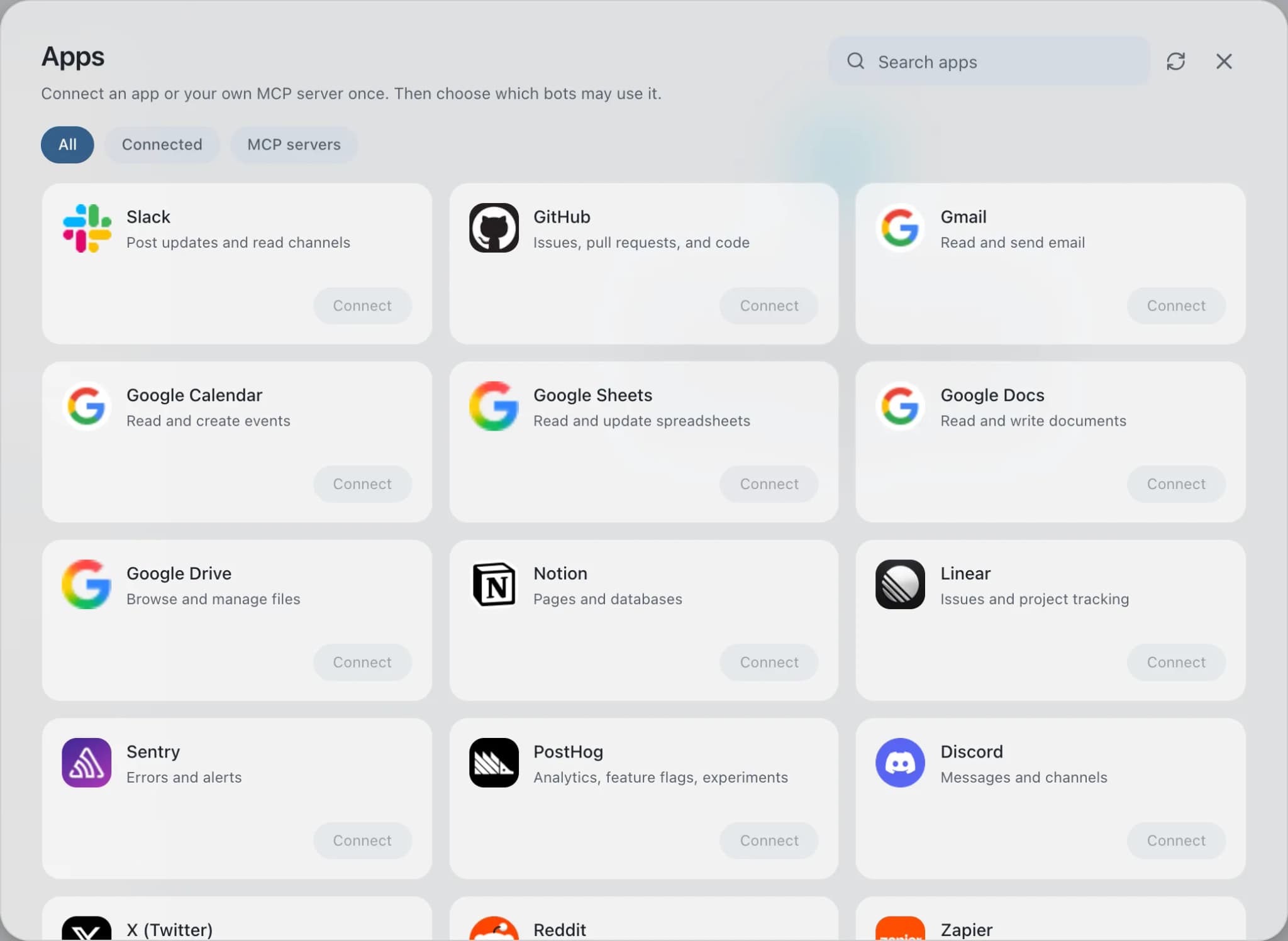
Connected apps in Brainwrite give bots secure tools for services like Gmail, GitHub, Slack and Notion, authorised through OAuth in your own browser via Composio. The official app sets this up automatically, so there is no key to paste. OAuth tokens stay with Composio, never in prompts, and you choose per bot whether it gets all of an app's tools, an exact list, or none.


Find my last email thread with Priya at Northwind Studio, draft a follow-up with the three action items, and add them to Notion.
Your Chief of Staff put a team on it
 Nova· Chief of Staff
 Dash· Inbox triager
 Sage· Reply drafter
- Found Tuesday's thread in Gmail (work).
- Drafted a follow-up listing the 3 action items.
- Prepared 3 Notion tasks under Northwind Studio.
Done1 email and 3 Notion tasks to approve: waiting for your yes.
 DashOperations3 apps connected
 AtlasResearchRead-only access
Follow up after a call: done. One thing waits for you.
- 1Found Tuesday's thread in Gmail (work).
- 2Drafted a follow-up listing the 3 action items.
- 3Prepared 3 Notion tasks under Northwind Studio.
 3 bots on this job
See it in the app
Connected apps in Brainwrite.
Why it matters
On your own, with a chatbot, and with Brainwrite.
| Doing it yourself | A single chatbot | Brainwrite | |
|---|---|---|---|
| Getting data in | Copy it from each app | Paste it into the chat | Bots call the app's tools through your OAuth connection |
| Who can do what | You are the access control | Depends on the product's connectors | Per bot: all tools, an exact list, or none |
| Work and personal accounts | Sign out and back in | Depends on the product | Up to five labelled accounts per app; the bot must pick one |
| Removing access | Change passwords | Disconnect in the product | Disconnect revokes access at the service itself |
How it works
How Connected apps works.
- 01
Open Connected apps
Choose Connected apps in the sidebar and search for the service.
- 02
Connect and label
Choose Connect, or Add account if you already have one, and give it a label such as work, personal or client-acme.
- 03
Authorise in your browser
Finish the OAuth sign-in in the browser window that opens, then return to the app.
- 04
Set per-bot grants
In a bot's settings under Connected apps, choose all tools, an exact list of tools, or no tools for each service.
- 05
Ask the bot
Ask the bot to use the service. Risky actions still reach you as approval cards.
Good to know
The details.
Several accounts per app
Connect up to five labelled accounts per app. When more than one could run an action, the bot must pick one explicitly; a new sign-in never silently replaces the old one.
Grants cover tools, not accounts
A grant says which tools a bot may call on a service and covers every account of that service. To keep a bot away from one account, use a separate installation.
Imported bots start with nothing
Imported bots and shared packages always land with no grants, so a shared persona cannot reach your Gmail on its first turn.
Ungranted tools are never offered
A tool a bot is not granted is never shown to the model, and every allow and deny is written to the decision log.
Disconnect means revoke
Disconnecting revokes that account's access at the service, not just in the app. Other accounts for the same app stay connected.
The edges, plainly
- X (Twitter) is not available, because X does not offer the shared sign-in the other services use.
- Until you assign a grant, every bot keeps all tools on the apps it can see.
- Each app is capped at five usable accounts per installation.
Use cases
Jobs this feature does for you.




Works with
Apps it's often used with.

Gmail
Bots search, label, and read Gmail threads and draft replies in place. Sending waits for your approval.

Slack
Bots search Slack, summarise channels and threads, and post or schedule updates once you approve.

GitHub
Triage GitHub issues, review pull requests, read failing workflow logs, and draft release notes. Merges wait for you.

Notion
Bots search Notion, read and write pages, query databases, and add or update rows and comments.
FAQ
Questions about Connected apps
Can AI agents access my Gmail?
Yes, if you connect it. Open Connected apps, search for Gmail, choose Connect and finish the OAuth sign-in in your browser. The token stays with Composio, never in a prompt. Then decide per bot whether it gets all Gmail tools, an exact list, or none.
Do I need a Composio API key to connect apps?
No. The official signed desktop app registers itself with Brainwrite's managed connected-apps service, so there is no Composio key to find or paste. A Composio project key is only needed if you deliberately run the integration yourself.
Can I connect a work and a personal Gmail account?
Yes. Connect each account separately and give it a label such as work or personal. Each app allows up to five usable accounts. When more than one account could perform an action, the bot must choose one explicitly instead of quietly using the first.
Can I post to X (Twitter) with Brainwrite?
Not through connected apps. X (Twitter) is not available yet, because X does not offer the shared sign-in that the other services use. Hundreds of other services, including Gmail, GitHub, Slack and Notion, are available.
Can I limit which app tools each AI agent can use?
Yes. In a bot's settings under Connected apps, choose per service whether the bot gets all tools, an exact list, or none. Once a bot has any grant, services missing from its list give it nothing, and ungranted tools are never offered to the model.
Works well with
Related features.

Custom MCP servers
Add MCP servers by command, URL or pasted config. Saved off; test, then turn on.

Approvals
Risky actions become cards you approve or deny in the conversation. Ask or Full Access per thread.

Secrets
Bots use API tokens by name. The value goes only to one https site and never reaches the chat.

Chief of Staff
One bot takes your request, hands focused tasks to specialists, and returns a single summary.





Give your first job to Brainwrite.
Download the app, connect the AI you already pay for, and tell your Chief of Staff what needs doing.
macOS today. Windows and Linux are coming soon.