Integration · Developer tools
GitHub AI agents for issues, reviews, and releases
Brainwrite connects GitHub to your AI agents so they can triage issues, review pull requests, read failing workflow runs, and draft release notes. A bot can label new issues, leave review comments on a diff, and tell you why a build failed from its logs. Merging a pull request waits for an approval card unless you've allowed it.
 Brainwrite · GitHub
List open pull requests in acme/web that have been waiting more than three days for review. For each, summarise the change in two sentences and note any failing checks.


You connect GitHub once. Your Chief of Staff puts a bot on it.
- Create issues, comment on them, and add labels and assigneesWaits for you
- List pull requests and read their changed files and commits
- Create a pull request review with line commentsWaits for you
- Merge a pull request (waits for an approval card unless you've allowed it)Waits for you
- List workflow runs and download job logs for a failed run
In GitHub
What your bots can do in GitHub.
- Create issues, comment on them, and add labels and assignees
- List pull requests and read their changed files and commits
- Create a pull request review with line comments
- Merge a pull request (waits for an approval card unless you've allowed it)
- List workflow runs and download job logs for a failed run
- Create a release and generate release notes
- Search repositories, issues, and code
Chief of Staff
- Issue triage
- First-pass PR review
- Why did CI fail?
Changes in GitHub wait for your approval in Ask mode
Jobs
Jobs your team does with GitHub.
Issue triage
A routine reads new issues, adds labels, asks for missing reproduction steps in a comment, and lists anything that looks urgent.
First-pass PR review
A bot reads a pull request's diff and leaves review comments on risky changes, missing tests, and unclear names before a person reviews.
Why did CI fail?
A bot downloads the failing job's logs, finds the first real error, and points to the commit that likely caused it.
Release notes
A bot lists merged pull requests since the last tag and drafts release notes grouped by feature, fix, and chore.
Set up
How to connect GitHub.
- 01
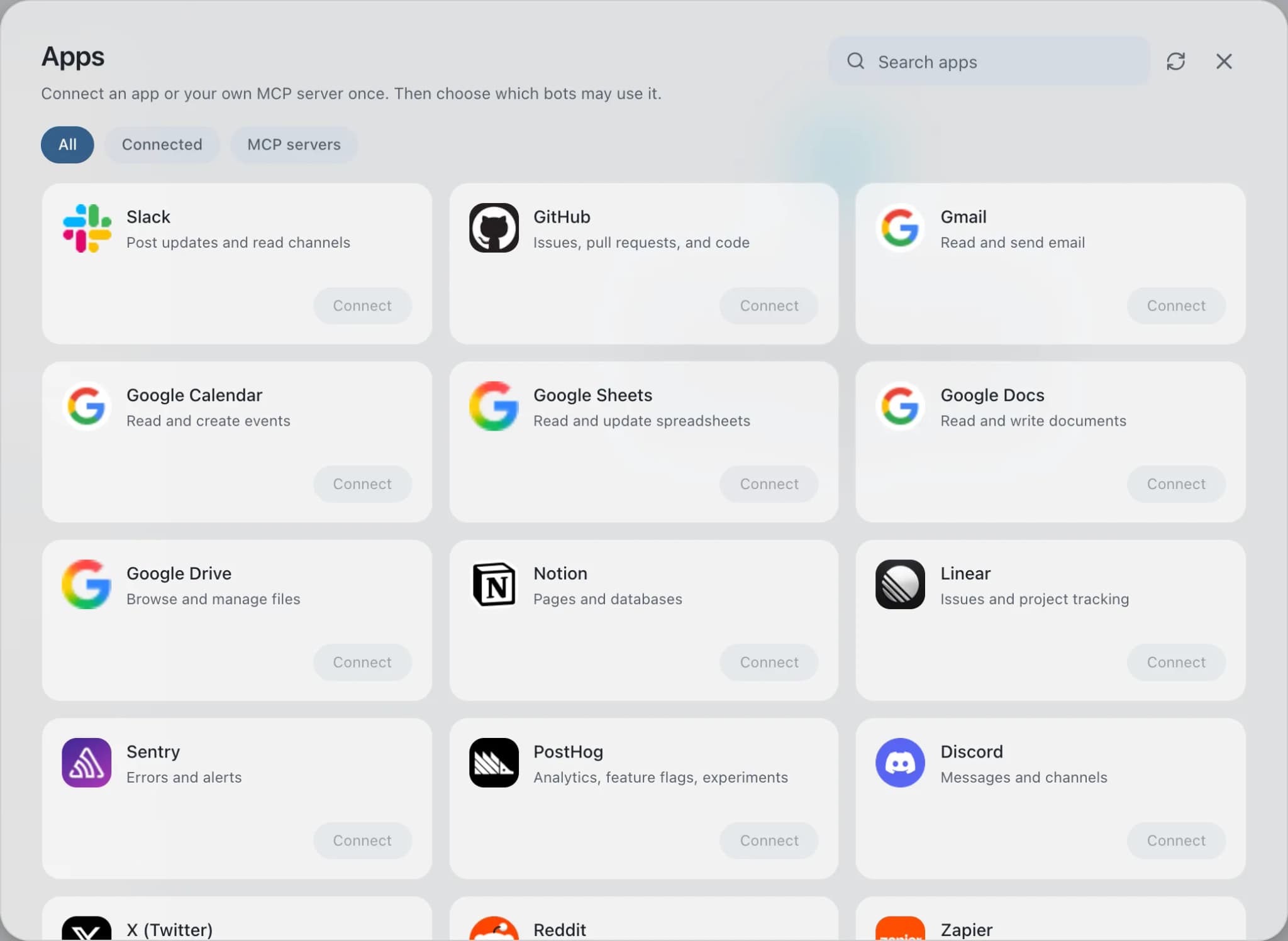
Open Connected apps
In Brainwrite, choose Connected apps in the sidebar. The official app sets up the connection service for you; there's no key to paste.
- 02
Search for GitHub
Find GitHub and choose Connect. You can add more than one account later and label each, such as work or a client.
- 03
Sign in in your browser
Finish GitHub's own sign-in in your normal browser. The access token stays with the connection service and never enters a bot's prompt.
- 04
Choose which bots get it
In each bot's settings, give it all tools, an exact list, or none. Imported bots start with none, so nothing reaches your account by surprise.
Put it to work
Use cases with GitHub.
Issue triage
A bot reads new issues, groups duplicates, and proposes labels, priority, and owners for you to approve.
Engineering
Release readiness
Rigel sweeps open pull requests each weeknight and reports what is ready, stalled, or failing. You merge.
Engineering
Weekly report
Each Friday the Chief of Staff gathers shipped work, open issues, and pipeline changes into one report you approve.
Operations
Ready-made teams that use GitHub: Ship Software Safely.
FAQ
Brainwrite and GitHub: questions
How do I connect GitHub to Brainwrite?
Open Connected apps, search for GitHub, and choose Connect. GitHub's authorization page opens in your browser; approve access and return to Brainwrite. Tokens stay with Composio and are never put in a bot's prompt. You can connect a personal and a work GitHub account side by side, each with its own label.
Can I let a bot review pull requests but never merge them?
Yes. In the bot's settings under Connected apps, switch GitHub to an exact list of tools. Include the pull request read and review tools and leave out merge and branch tools. The merge tool is then never offered to that bot. Even when it is granted, a merge waits for an approval card unless you've allowed it.
Does the Engineering team in the team library use GitHub?
Yes. The Engineering team lists GitHub as an optional app, used to read repositories, issues, pull requests, and checks. When you add the team, its bots arrive with no app grants, so nothing touches GitHub until you connect it and grant tools to the bots you choose.
Can a bot also work on the code itself?
The GitHub connector works through GitHub's API: issues, reviews, workflow runs, releases. For editing and running code, give the bot a computer, such as a local VM or your own Linux server, and a working folder. Many teams use both: the computer for the change, GitHub tools for the pull request.
Developer tools
More developer tools.

GitLab
Review GitLab merge requests, triage issues, read failing pipeline jobs, and keep merges behind your approval.

Bitbucket
Review Bitbucket pull requests, check Pipelines, search code, and keep merges behind your approval.

Sentry
Triage new Sentry errors, read events and tags, check release health, and resolve or assign issues.

Vercel
Check Vercel deployments, read build and runtime logs, verify domains, and keep production promotions behind approval.





Give your AI team GitHub.
Download the app, connect the AI you already pay for, and tell your Chief of Staff what needs doing.
macOS today. Windows and Linux are coming soon.