Use case · Marketing
Launch one focused campaign with a clear stop-or-scale rule
To plan a launch campaign with AI agents, install the Launch a Measurable Campaign team in Brainwrite and describe the launch. Maya picks one audience and growth bet, Echo writes the message and assets, Orbit builds a channel-by-channel distribution plan, and Lens sets the baseline and decision threshold. You get one owned plan instead of four separate documents.


We launch our scheduling add-on next month. Build one focused campaign with positioning, creative angles, distribution, measurement, and a stop-or-scale rule.
Your Chief of Staff put a team on it
 Atlas· Maya, Growth Lead
 Sage· Echo, Creative and Copy Lead
 Dash· Orbit, Distribution Lead
 Penny· Lens, Growth Analyst
- Bet: clinic managers who rebook by phone; promise: fewer no-shows from self-serve rescheduling (hypothesis, proof needed)
- Asset set: 1 landing page, 3 email variants, 4 LinkedIn posts, all on the same claim
- Distribution: 10 dated steps across email, LinkedIn, and one partner newsletter, each with an owner
- Primary metric: trial starts from the landing page; scale above 4%, stop below 1.5% after 3 weeks
DoneSaved as a routine: Fridays at 15:00. It starts paused until you turn it on.


Launch campaign: done. Nothing sent.
- 1Bet: clinic managers who rebook by phone; promise: fewer no-shows from self-serve rescheduling (hypothesis, proof needed)
- 2Asset set: 1 landing page, 3 email variants, 4 LinkedIn posts, all on the same claim
- 3Distribution: 10 dated steps across email, LinkedIn, and one partner newsletter, each with an owner
4 bots on this jobThe job
Doing it yourself, and handing it off.
Doing it yourself
Launches sprawl. Someone writes positioning, someone else writes ad copy that promises something slightly different, the social plan lists every channel at once, and nobody decides beforehand what result would count as success. Two weeks later the numbers are ambiguous and the team argues about whether to keep going. The work is real, but without one bet, one message, and one metric, it is hard to learn anything from it.
What the team does
- Write a positioning brief that marks unproven claims as hypotheses
- Produce channel-ready copy and asset variations around one message
- Build a distribution sequence with owners and dates
- Define the metric, baseline, and threshold before launch
What waits for you
- The bet and the budget
- Every post, email, and ad before it goes out
- Whether to stop, iterate, or scale
See it in the app
What it looks like in Brainwrite.
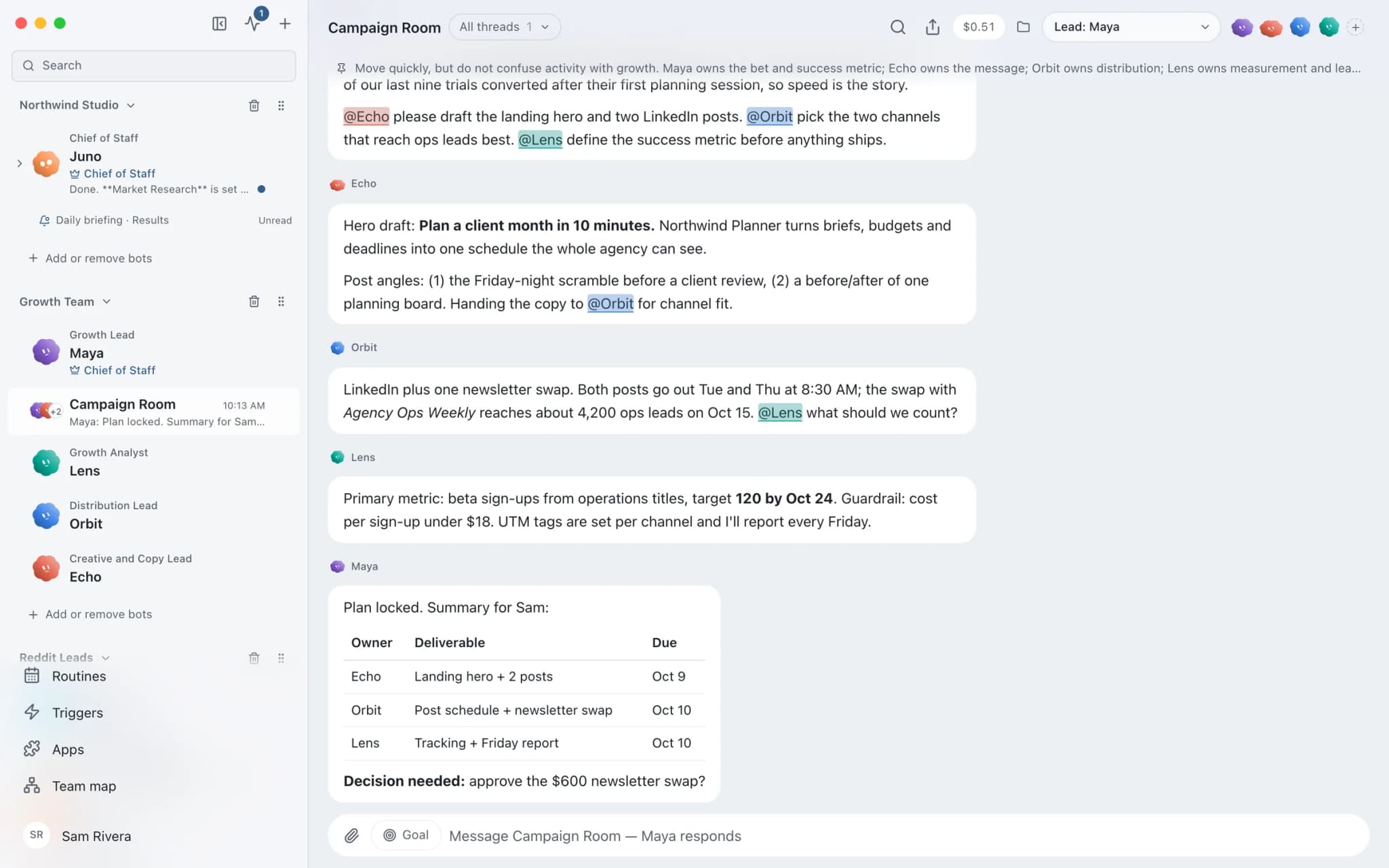
A real screenshot from a demo workspace.
The team
Who's on it.
Your Chief of Staff picks the specialists the job needs. Each has its own role, instructions, model, and app access.
 AtlasIllustrated example
Maya, Growth Lead
Turns the goal into one audience, promise, and success metric, and says no to activity that does not serve the bet.
 SageIllustrated example
Echo, Creative and Copy Lead
Writes the concept and copy from a real customer insight with credible proof. No fake testimonials or invented urgency.
 DashIllustrated example
Orbit, Distribution Lead
Plans owned, earned, partner, community, and paid channels with cadence, owners, and dependencies.
 PennyIllustrated example
Lens, Growth Analyst
Sets the primary metric, baseline, time window, and decision threshold before launch, and reads the results afterwards.
How it runs
A run, step by step.
- 01
Position
Maya clarifies the audience, situation, current alternative, and promise. Claims without proof are marked as hypotheses.
- 02
Make the assets
Echo builds the minimum asset set for each chosen channel, with variations that keep the same underlying claim.
- 03
Plan distribution
Orbit sequences the launch with owner, date, audience, and adaptation for each channel.
- 04
Measure and decide
Lens's weekly experiment review runs Fridays at 15:00 and recommends stop, iterate, scale, or gather more data.
Start faster
Ready-made teams for this job.
Add a team from the library in one click. You see a preview first; routines arrive paused and connected apps stay off until you approve them.
What you'll connect
Apps this job uses.

Google Sheets
Bots read and write Google Sheets, append and upsert rows, and add charts to trackers and reports.

Slack
Bots search Slack, summarise channels and threads, and post or schedule updates once you approve.

LinkedIn
Draft LinkedIn posts and comments, read company page and share stats, and publish only after you approve.

Mailchimp
Bots draft Mailchimp campaigns, manage tags and segments, and read reports. Sends and schedules wait for you.
FAQ
Questions about Launch campaign
Will the agents post or run ads for me?
Not by default. The team plans and drafts; posts, emails, and ads wait for you. If you connect an app such as LinkedIn or Mailchimp, actions through it appear as approval cards in Ask mode. Ad spend is always your decision, and Brainwrite's plans include neither ad budget nor AI usage.
How does it decide whether the campaign worked?
Lens defines measurement before launch: one primary metric, supporting diagnostics, a baseline, a time window, and a decision threshold. In the weekly review it flags tracking or sample-quality problems, separates correlation from causation, and recommends stop, iterate, scale, or gather more data, with an owner and date for each next action.
Does it make up customer quotes or results?
The team's rules forbid it. The shared instructions say not to fabricate customers, results, urgency, or data, and Echo is told to avoid fake testimonials and empty superlatives. Claims without proof are marked as hypotheses in the positioning brief, so you can see what still needs evidence.
Built on
Features this job relies on.
Team library
Add a ready-made team of bots in one click. Preview first; routines arrive paused and apps stay off.
Threads and groups
Up to three independent threads per bot, plus group chats where several bots share one brief.
Routines
Run a bot's task once, on an interval, or on chosen weekdays, with a receipt for every run.
Approvals
Risky actions become cards you approve or deny in the conversation. Ask or Full Access per thread.
Keep going
Put a team on something else.










Give your first job to Brainwrite.
Download the app, connect the AI you already pay for, and tell your Chief of Staff what needs doing.
macOS today. Windows and Linux are coming soon.